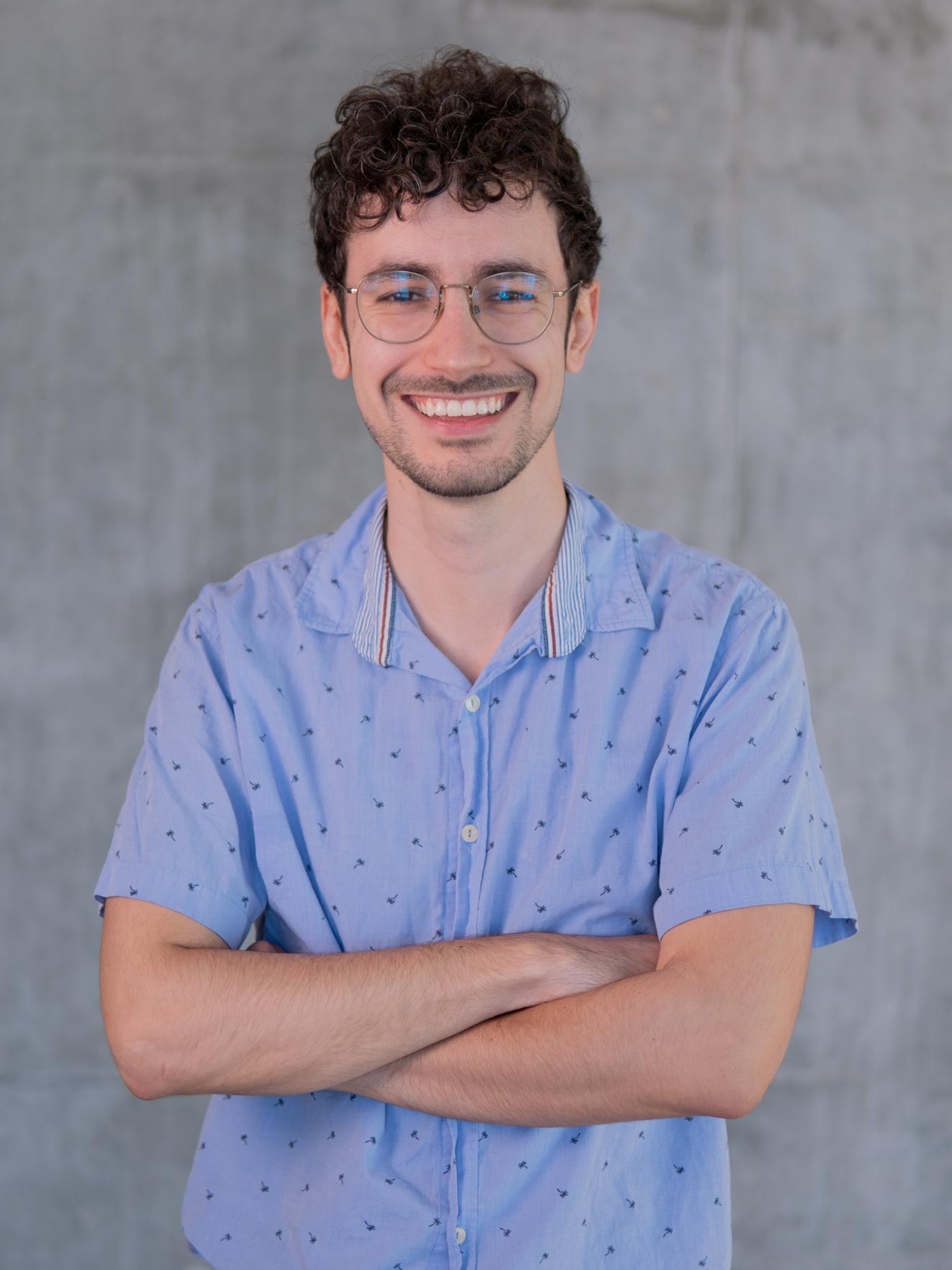
Victor Klein-Sousa
University of Copenhagen
Nicholas Taylor Group, Novo Nordisk Foundation Center for Protein Reseach.
Victor is a PhD fellow in the Nicholas M. I. Taylor Group at the Novo Nordisk Foundation Center for Protein Research, University of Copenhagen. He is a physicist by training, with research interests in virus–host interactions, protein evolution, and structural biology. During his PhD, he has focused on phage receptor-binding proteins, developing tools to study their structure and applying cryo-electron microscopy to investigate virions. He has also contributed to research on anti-phage defense systems.
Affiliations: (1). Structural Biology of Molecular Machines Group, Protein Structure & Function Program, Novo Nordisk Foundation Center for Protein Research, Faculty of Health and Medical Sciences, University of Copenhagen, Blegdamsvej (3)B, (2200) Copenhagen (Denmark) (2). Core Facility of Integrated Microscopy at University of Copenhagen (CFIM), Copenhagen, (Denmark)
Phage infection begins with host recognition and proceeds through genome translocation across the cell membrane. Here, we investigate both processes using a combination of computational and experimental structural biology. Receptor-binding proteins (RBPs) are essential for phage adhesion, yet their sequence and structural diversity remain poorly characterized. Tail fibers, a major class of RBPs, are elongated, flexible trimers, making their full-length structures difficult to resolve experimentally. To address this, we developed RBPseg, a computational pipeline that integrates monomeric predictions with a structure-based domain identification strategy. This approach segments tail fiber sequences into tractable units for high-confidence modeling using AlphaFold-Multimer (AFM), outperforming AFM alone. Using RBPseg, we generated complete tail fiber models for mostly E. coli phages. We validated our predictions through single-particle cryo-electron microscopy on three BASEL phages. A structural classification of 67 tail fibers revealed 16 distinct classes and 89 domains, uncovering patterns of modularity, convergence, divergence, and domain swapping. These classes account for an estimated 24% of the known tail fiber sequence space. We are currently expanding this atlas with RBPseg models for over 4,000 RBPs from diverse phages. Part of the work has been recently published at Science Advances: https://www.science.org/doi/full/10.1126/sciadv.adv0870